Call
Call  Schedule Online
  Contact






Merkel Cell Carcinoma is another form of skin cancer that tends to be even more aggressive than melanoma and sometimes referred to as a neuroendocrine carcinoma. Merkel Cell Carcinoma is rare. Rarer than melanoma.
However, every year we see these come into our office. We are not certain exactly what causes a Merkel Cell Carcinoma to appear. There is some evidence that sun exposure plays a role as most of these carcinomas appear on the head and neck in sun exposed areas. Also, there is more recent evidence that shows there might be a virus that lives on our skin that plays a role in the development of this carcinoma. Bottom line is we are not sure exactly how and why it develops.
Technically, anyone could develop a Merkel Cell Carcinoma.
There are certain risk factors that seem to be more prevalent in those that develop this carcinoma. Excess UV exposure throughout your lifetime including tanning bed use, history of previous skin cancers such as squamous and basal cell carcinomas, fairer skin types, and generally those with a weakened immune system from something like organ transplants or even HIV.

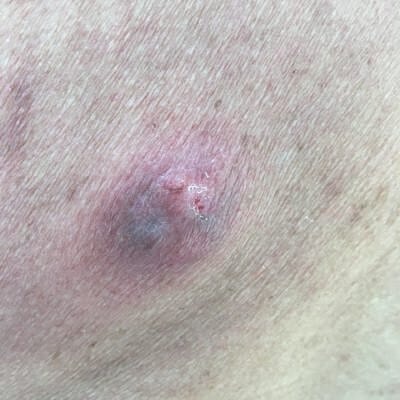
Just like any skin cancer, you are looking for something new to appear on your skin or something to be changing on your skin. Merkel Cell Carcinoma tends to be red or violaceous in color.
This type of carcinoma tends to enlarge over time, and just like other skin cancers it can bleed. If you are looking over your skin once a month for new or changing lesions you might recognize a new or changing spot. This is the best way to spot it along with yearly skin cancer screenings in the office. If a suspicious spot is found during your skin cancer screening it will be biopsied.
Stages of Merkel Cell Carcinoma
There are three stages of Merkel Cell Carcinoma. There is no agreed upon staging for this type of carcinoma, but one of the most common and widely used is the system suggested by Yiengpruksawan et al, which uses three stages.
About 55% of patients have stage 1 disease when first diagnosed.
Stage I – Absence of lymphadenopathy
Stage IA – Tumors < 2 cm
Stage IB – Tumors > 2 cm
About 31% of patients have stage 2 disease when first diagnosed.
Stage II – Positive regional lymphadenopathy
About 6% of patients have stage 3 disease when first diagnosed and tends to carry a very poor prognosis.
Stage III – Evidence of distant metastases

After confirmation that you have a Merkel Cell Carcinoma there are several steps that need to occur. The first step may be to obtain CT or PET imaging of your entire body looking for metastases as this carcinoma tends to spread followed by wide local excision of the carcinoma.
Wide local excision meaning possibly 1 to 3 cm of clear margins. This is larger than some melanoma excisions. If there happens to be lymph node involvement the involved lymph nodes are typically removed during surgery. Depending on the staging of the carcinoma and whether there are metastases, it may be necessary to work with an oncologist. The oncologist may recommend and prescribe chemotherapy, radiation, or even newer immunotherapy options.




There’s med spas, and then there’s Ocean Drive Med Spa. Led by Dr. Alan Durkin, Ocean Drive Med Spa is well known among industry professionals as a center for innovation.
Pioneering new technologies and treatments, Ocean Drive Med Spa constantly researches new technologies to ensure the best results for its patients. Ocean Drive Med Spa also features one of the largest laser and energy centers in the nation, offering patients treatments with the latest state-of-the-art tools to create incredible aesthetic experiences. Begin yours today with an appointment at Ocean Drive Med Spa.